How to Calculate GST in India: Complete Step-by-Step Guide (2026)
Master GST calculation in India with step-by-step formulas, GST 2.0 updated rates (5%, 18%, 40%), real business examples, ITC extraction, reverse charge calculation, and invoice compliance rules. Updated for September 2025 GST reforms.
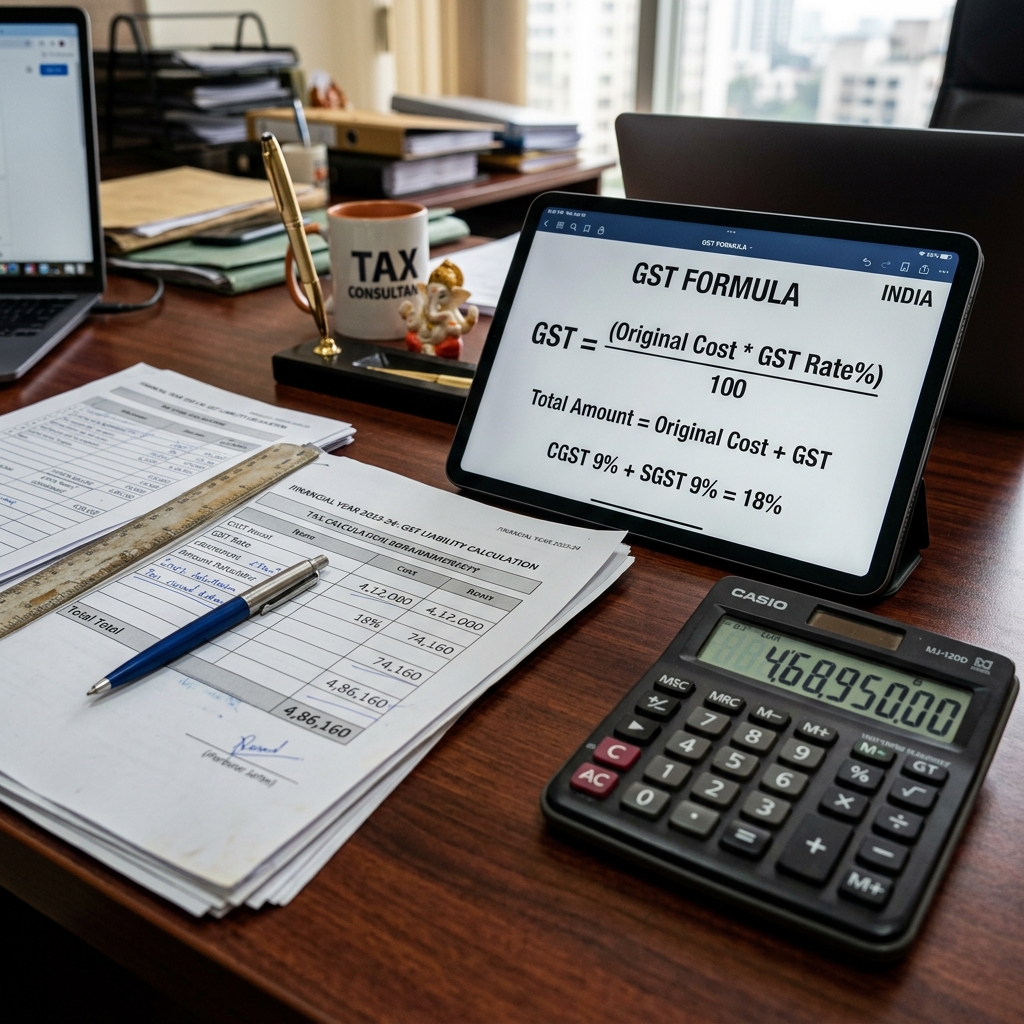
How to Calculate GST in India: Complete Step-by-Step Guide (2026) GST calculation errors are one of the most common — and most costly — compliance mistakes Indian businesses make. An incorrect figure on a single invoice can mean a denied Input Tax Credit for your buyer, a demand notice from the GST authorities, interest charges at 18% per annum, and a damaged business relationship. This guide gives you every GST calculation method you need: exclusive (add tax to price), inclusive (extract tax from total), multi-rate invoices, Reverse Charge Mechanism, ITC reconciliation, and composition scheme rates — all with real Indian business examples and the updated GST 2.0 rates effective September 22, 2025.
Table of Contents
GST 2.0: Updated Rate Structure (September 2025) Two Methods: Exclusive vs Inclusive Calculation Method 1: Exclusive GST Calculation (Net + Tax) Method 2: Inclusive GST Calculation (Extract from Total) How CGST, SGST, and IGST Split Works Multi-Rate Invoice Calculation Reverse Charge Mechanism (RCM) Calculation Input Tax Credit (ITC) Calculation Composition Scheme Calculation Real-World Business Examples GST on Advance Payments, Discounts, and Shipping Invoice Compliance Checklist 2026 Updates: What Changed in GST Calculation Common Calculation Mistakes and How to Fix Them Frequently Asked Questions
- GST 2.0: Updated Rate Structure (September 2025)
Critical update for 2026: The 56th GST Council meeting (September 3, 2025) approved India's most significant GST reform since 2017. The GST 2.0 structure, effective September 22, 2025, replaced the old four-tier system (5%, 12%, 18%, 28%) with a simplified structure. If you are still applying 12% or 28% rates on standard goods and services, your invoices are now incorrect.
Current GST 2.0 Slabs SlabCategoryWhat it Covers0%Nil / ExemptEssential goods: unpackaged food, fresh vegetables, milk, eggs, life-saving drugs, educational services, healthcare5%Merit rateSemi-processed foods, gold (3% special rate), essential household goods, small car segments previously at 12%18%Standard rateMost goods and services: packaged foods, electronics, ACs, TVs, washing machines, cement, IT services, professional services, software, web development, digital marketing40%Demerit / Sin goodsUltra-luxury vehicles, tobacco, cigarettes, pan masala, carbonated beverages, online gaming What Changed vs the Old Structure Old RateNew RateExamples28%18%Air conditioners, large TVs, washing machines, cement28%40%Pan masala, tobacco products, high-end luxury cars12%5%Most items previously in the 12% bracket (processed foods, computers)12%18%Some items reclassified upward Special rates that continue: 3% on gold jewellery and precious metals; 0.25% on rough diamonds.
For most service businesses (IT, web development, consulting, digital marketing, SaaS, automation): the applicable rate remains 18% under the standard slab. No change here.
-
Two Methods: Exclusive vs Inclusive Calculation Every GST calculation in India falls into one of two scenarios: Exclusive (tax-exclusive): You quote a base price and add GST on top. The customer pays base + GST. Used in most B2B invoicing. Inclusive (tax-inclusive): You quote a final price that already contains GST. You need to extract the tax component to report it correctly. Common in B2C retail, restaurants, and consumer services. Knowing which method applies to your situation is the first step before any calculation.
-
Method 1: Exclusive GST Calculation Use this when your quoted/listed price is the base price before tax. Formula GST Amount = Base Price × GST Rate ÷ 100 Total Price = Base Price + GST Amount Step-by-Step
Identify the base price (amount before GST) Confirm the applicable GST rate (5%, 18%, or 40%) Multiply: Base × Rate ÷ 100 = GST amount Add GST to base to get invoice total Split GST into CGST + SGST (intrastate) or show as IGST (interstate)
Example — Web Development Invoice (B2B, Interstate) A Hyderabad web agency raises an invoice to a client registered in Mumbai. ItemAmountBase price (website project)₹75,000GST rate18%GST amount (₹75,000 × 18 ÷ 100)₹13,500Invoice total₹88,500 Since this is interstate (Telangana → Maharashtra): Tax ComponentRateAmountIGST18%₹13,500 Example — Same Transaction, Intrastate Same agency, client also in Hyderabad (intrastate — Telangana to Telangana): Tax ComponentRateAmountCGST9%₹6,750SGST9%₹6,750Total GST18%₹13,500 Invoice total: ₹88,500 — the same. Only the tax component labels change.
- Method 2: Inclusive GST Calculation Use this when your quoted price already includes GST — common in restaurants, retail, and consumer-facing pricing. Formula GST Amount = Total Price × GST Rate ÷ (100 + GST Rate) Base Price = Total Price − GST Amount Why this formula? The logic explained If you charged ₹1,000 inclusive of 18% GST, the base is not ₹820 (₹1,000 − 18%). That would only be correct if 18% of ₹820 equals ₹180 — but 18% of ₹820 is ₹147.6. The correct base is the amount where 18% of that base equals the GST embedded in ₹1,000. Working backwards: Base × 1.18 = ₹1,000 → Base = ₹1,000 ÷ 1.18 = ₹847.46 The formula Total × Rate ÷ (100 + Rate) gets there directly: ₹1,000 × 18 ÷ 118 = ₹152.54 GST → Base = ₹847.46 ✓ Example — Restaurant Bill (5% GST, Intrastate) A restaurant in Delhi quotes ₹2,360 for a meal (GST-inclusive). What is the tax component? ItemAmountTotal inclusive price₹2,360GST rate5%GST = ₹2,360 × 5 ÷ 105₹112.38Base price = ₹2,360 − ₹112.38₹2,247.62CGST (2.5%)₹56.19SGST (2.5%)₹56.19 Example — Retail Clothing (18% GST, Intrastate) A shopkeeper sells a shirt for ₹1,180 inclusive of GST. ItemAmountTotal inclusive price₹1,180GST rate18%GST = ₹1,180 × 18 ÷ 118₹180.00Base price = ₹1,180 − ₹180₹1,000.00CGST (9%)₹90.00SGST (9%)₹90.00
Pro tip: Note that ₹1,180 at 18% gives a clean ₹180 GST because the base is a round ₹1,000. In practice, most inclusive calculations produce decimals — always round only the final invoice total, never intermediate tax figures.
- How CGST, SGST, and IGST Split Works The total GST rate always stays the same. What changes is how it's divided. Intrastate (same state): CGST + SGST The total GST is split 50/50 between the Centre and the State government. Total RateCGSTSGST5%2.5%2.5%18%9%9%40%20%20% Both CGST and SGST must be shown as separate line items on the invoice. Interstate (different states): IGST The total GST is charged as a single IGST. The Centre collects it and disburses the state's share to the destination state. Total RateIGST5%5%18%18%40%40% Union Territory transactions: CGST + UTGST For transactions within a Union Territory (Delhi, Chandigarh, etc.), CGST + UTGST apply — same split as CGST+SGST, but UTGST replaces SGST.
The rule: Supplier state = Place of Supply state → CGST+SGST. Different → IGST. See our GST Place of Supply guide for the full decision framework.
-
Multi-Rate Invoice Calculation Many invoices include goods or services taxed at different rates. Each line item must be calculated separately. Example — IT Firm Invoice with Multiple Services A Bengaluru IT firm (intrastate client in Bengaluru) raises an invoice: ServiceBase AmountGST RateGST AmountWeb development₹40,00018%₹7,200Hardware (laptop)₹60,00018%₹10,800Training (in-person)₹10,00018%₹1,800Total base₹1,10,000 Since all items are at 18% here, the combined GST is ₹19,800. But if services and goods at different rates were mixed, they must still be listed separately. You cannot average rates or apply one rate to a combined total. Intrastate CGST/SGST breakdown: ComponentAmountCGST @ 9%₹9,900SGST @ 9%₹9,900Total GST₹19,800Invoice total₹1,29,800 Multi-Rate Example — Mixed GST Rates A packaged food distributor supplies: ItemBaseRateGSTBranded spices₹20,0005%₹1,000Packaged biscuits₹30,00018%₹5,400Mineral water₹10,00018%₹1,800Totals₹60,000₹8,200 Invoice total: ₹68,200. The GST figures must be listed separately by rate in GSTR-1.
-
Reverse Charge Mechanism (RCM) Calculation The Reverse Charge Mechanism (RCM) is one of the most frequently missed compliance requirements. Under RCM, you — the buyer — calculate and pay GST to the government, not the supplier. The supplier does not charge GST on their invoice. When Does RCM Apply? Scenario 1 — Notified goods/services (Section 9(3) CGST Act) Specific categories notified by the government, including:
Services from a Goods Transport Agency (GTA) Legal services from an advocate to a business Services by a director to their company Renting of commercial property from an unregistered landlord (added per 54th GST Council) Sponsorship services from a non-body-corporate supplier
Scenario 2 — Purchase from an unregistered supplier (Section 9(4) CGST Act) When a GST-registered business buys from a supplier who is not registered under GST, RCM may apply depending on the nature of the supply and government notifications in force. RCM Calculation Formula RCM GST = Purchase Value × Applicable GST Rate ÷ 100 The GST rate used is the same rate that would have applied if the supplier were registered. Example — Office Rent from Unregistered Landlord A registered business in Pune pays ₹50,000/month rent to an unregistered landlord. ItemAmountMonthly rent₹50,000Applicable GST rate18%RCM GST = ₹50,000 × 18 ÷ 100₹9,000 The business pays ₹9,000 directly to the government via its GSTR-3B (Table 3.1(d)), and can claim ₹9,000 as ITC in Table 4(A)(2) of the same return — if the premises is used for taxable business purposes. Example — Goods Transport Agency (GTA) A Delhi exporter pays ₹80,000 to a GTA (not opting for forward charge) to transport goods. ItemAmountTransport charge₹80,000GST rate on GTA services5%RCM GST = ₹80,000 × 5 ÷ 100₹4,000 The exporter pays ₹4,000 under RCM and reports it in GSTR-3B.
Important: RCM tax must be paid in cash — it cannot be paid using ITC balance. After payment, ITC can be claimed in the same tax period.
- Input Tax Credit (ITC) Calculation Input Tax Credit is the mechanism by which GST paid on purchases is offset against GST collected on sales. Correct ITC calculation is how businesses avoid paying GST twice. ITC Calculation Formula Net GST Payable = Output GST (collected on sales) − Input GST (paid on purchases) If Output GST > Input GST → Pay the difference If Input GST > Output GST → Carry forward as credit (or claim refund in certain cases) Full Business Cycle Example — Clothing Retailer Amit's store in Delhi (intrastate B2C sales): Purchases this month:
Bought shirts from manufacturer: 50 shirts × ₹600 = ₹30,000 base GST paid (12% — shirts): ₹3,600 ITC available: ₹3,600
Sales this month:
Sold 50 shirts × ₹1,100 = ₹55,000 base GST collected (12%): ₹6,600 Output GST: ₹6,600
Net GST payable: AmountOutput GST collected₹6,600Less: ITC on purchases₹3,600Net payable to government₹3,000 Amit deposited ₹3,000 to GSTR-3B, not ₹6,600 — saving ₹3,600 through ITC. ITC Utilisation Order (Post February 2026) From February 2026, the GST portal allows greater flexibility in how ITC is utilised:
First, exhaust IGST ITC — it can offset IGST, CGST, or SGST liability Once IGST ITC is exhausted, use CGST ITC to pay CGST or IGST (in any sequence) Use SGST ITC to pay SGST or IGST (in any sequence)
Before February 2026, the sequence was rigid. The 2026 reform allows CGST and SGST to offset IGST in any order once IGST ITC is zero — giving businesses more working capital flexibility.
ITC Eligibility — Key Conditions (Section 16, CGST Act) ITC is claimable only when all four conditions are met:
You possess a valid tax invoice or debit note You have received the goods or services The supplier has filed their GSTR-1 and the transaction appears in your GSTR-2B You have filed your own GST returns
ITC cannot be claimed on: personal expenses, food and beverages (unless resale/input service), motor vehicles (unless transport business), club memberships, or construction of immovable property.
- Composition Scheme Calculation Businesses with aggregate annual turnover below ₹1.5 crore (₹75 lakh for special category states and service providers) can opt for the GST Composition Scheme — a simplified flat-rate alternative. Composition Scheme Rates Business TypeComposition GST RateNotesManufacturers1% (0.5% CGST + 0.5% SGST)On turnoverTraders (goods)1% (0.5% CGST + 0.5% SGST)On turnoverRestaurants (non-AC)5% (2.5% CGST + 2.5% SGST)On turnoverService providers6% (3% CGST + 3% SGST)On turnover Composition Scheme Calculation Formula GST Payable = Total Turnover (for the quarter) × Applicable Composition Rate ÷ 100 Example — Small Retailer Ravi runs a grocery store in Coimbatore with quarterly turnover of ₹8,00,000. ItemAmountQuarterly turnover₹8,00,000Composition rate (trader)1%GST payable = ₹8,00,000 × 1 ÷ 100₹8,000CGST (0.5%)₹4,000SGST (0.5%)₹4,000 Paid quarterly via CMP-08. Critical Composition Scheme Limitations
Cannot issue a GST tax invoice — must issue a Bill of Supply Cannot charge GST separately from customers — the tax is absorbed by the business Cannot claim ITC on purchases Cannot supply goods or services interstate Must display "Composition Taxable Person, not eligible to collect tax on supplies" on all business premises and bills
-
Real-World Business Examples Example A — Freelance Digital Marketer (Interstate, 18%) Priya provides digital marketing services from Chennai to a client registered in Bengaluru. ServiceBase AmountSocial media management₹25,000SEO campaign₹15,000Email marketing₹10,000Total base₹50,000 Interstate (Tamil Nadu → Karnataka) → IGST: IGST @ 18%₹9,000Invoice total₹59,000 Example B — SaaS Subscription (B2B, Intrastate, 18%) VSNEXOS raises a monthly SaaS invoice to a client in Hyderabad. Subscription fee₹12,000CGST @ 9%₹1,080SGST @ 9%₹1,080Invoice total₹14,160 Example C — E-Commerce Seller (Goods, Interstate, 18%) An electronics seller in Gujarat ships a laptop to a buyer in Kerala. Laptop price₹65,000IGST @ 18%₹11,700Invoice total₹76,700 Place of Supply = Kerala (delivery location) → Interstate → IGST. Example D — Construction Contractor (Multiple Rates + RCM) A registered contractor in Mumbai works on a project. Monthly purchase includes: PurchaseAmountRateGST PaidCement (from registered supplier)₹2,00,00018%₹36,000Steel (from registered supplier)₹1,50,00018%₹27,000Labour (from unregistered gang)₹50,00018% RCM₹9,000 (paid by contractor) Total ITC available: ₹36,000 + ₹27,000 + ₹9,000 = ₹72,000
-
GST on Special Cases: Advances, Discounts, and Shipping Advance Payments GST is applicable on advance payments for goods only if the goods have not been supplied yet and GST becomes payable at the time of advance receipt. For services, GST on advance becomes applicable when the advance is received (time of supply for services under Section 13 of CGST Act). Practical note: Many small businesses incorrectly hold GST until invoice date on advance payments for services. This can create a tax period mismatch. Trade Discounts A trade discount deducted before issuing the invoice reduces the taxable value — GST applies on the discounted price. A discount given after issuing the invoice (post-supply discount) must be linked to the original invoice via a credit note to reverse GST on the discount portion. Example:
Original invoice: ₹1,00,000 + 18% GST = ₹1,18,000 Post-supply discount of ₹10,000 (credit note issued) Credit note for: ₹10,000 + ₹1,800 GST = ₹11,800
Shipping and Freight Charges Freight is a taxable supply. The GST rate on freight depends on how it is charged: Freight ScenarioGST RateGTA services (by road) — non-RCM5% or 12%GTA services — RCM (buyer pays)5%Courier services (by air/rail)18%Freight bundled into invoice as part of saleSame rate as the main supply If freight is shown as a separate line item, use the applicable rate for that service. If bundled, it takes the rate of the primary goods.
-
Invoice Compliance Checklist A GST invoice that is missing mandatory fields can result in ITC rejection for your buyer. Under Rule 46 of the CGST Rules, every B2B GST invoice must contain: #Required FieldNotes1Supplier nameAs per GST registration2Supplier GSTIN15-digit alphanumeric3Supplier addressRegistered place of business4Invoice numberSequential, max 16 characters5Invoice dateDate of supply6Buyer nameAs per GSTIN records7Buyer GSTINFor B2B transactions8Buyer addressRegistered address9Place of SupplyState name and code10HSN/SAC code4, 6, or 8 digits (based on turnover)11Description of goods/servicesClear item-wise description12Quantity and unitWith UQC (Unique Quantity Code)13Taxable valueAfter discounts, before tax14GST ratePer line item15Tax amountCGST + SGST or IGST separately16Total invoice valueSum of taxable value + all taxes17Reverse charge"Yes" if RCM applies18SignatureDigital or physical HSN/SAC Code Requirements by Turnover Annual TurnoverHSN Digits RequiredUp to ₹5 crore4-digit HSNAbove ₹5 crore6-digit HSNExporters / specific categories8-digit HSN
-
What Changed in 2026 GST 2.0 Rate Rationalization (September 22, 2025) The most significant GST change since 2017. The 56th GST Council meeting restructured India's tax slabs:
12% slab eliminated — items moved to 5% (majority) or 18% 28% slab eliminated — items moved to 18% (majority) or 40% New 40% demerit rate created for luxury, sin, and harmful goods Net result: ~200 products and services got rate cuts including electronics, automobiles, and daily-use goods
What this means for your calculations: If you were applying 12% or 28% to any product or service and haven't updated your invoicing software or templates, your invoices since September 22, 2025 are wrong. ITC Utilisation Flexibility (February 2026) CGST and SGST ITC can now be used against IGST liability in any sequence once IGST ITC is exhausted. Businesses with high interstate supply volumes benefit most — more efficient use of accumulated ITC credits. 3-Year Return Filing Cut-Off (Enforced from 2025) The GSTN portal now hard-locks GST returns beyond a 3-year window. If you have pending amendments, credit note adjustments, or POS corrections from FY 2022-23 or earlier, the window to fix them may have closed.
- Common Calculation Mistakes and How to Fix Them Mistake 1: Using 12% or 28% rates after September 2025 The 12% and 28% slabs were eliminated on September 22, 2025. Applying them to new invoices is a compliance error. Check each product's current rate on the CBIC GST rate schedule or HSN Rate Finder. Fix: Update your invoicing software or product master list with correct GST 2.0 rates.
Mistake 2: Extracting GST from inclusive prices incorrectly A common error: calculating inclusive GST as Total × Rate ÷ 100 instead of Total × Rate ÷ (100 + Rate). Wrong: ₹11,800 × 18 ÷ 100 = ₹2,124 (incorrect) Correct: ₹11,800 × 18 ÷ 118 = ₹1,800 (correct) Fix: Use the correct formula or a GST calculator at all times for inclusive pricing.
Mistake 3: Showing lump-sum GST instead of CGST/SGST split An invoice showing "GST: ₹9,000" without breaking it into CGST (₹4,500) + SGST (₹4,500) is non-compliant under Rule 46 of the CGST Rules. The buyer cannot claim ITC on such an invoice. Fix: Always show CGST and SGST as separate line items on intrastate invoices; IGST as a separate line item on interstate invoices.
Mistake 4: Not applying RCM on purchases from unregistered suppliers Thousands of registered businesses buy from unregistered vendors — freelancers, small suppliers, unregistered contractors — and never account for the GST liability this creates. This is discovered during audits and results in demand + interest at 18%. Fix: Identify all purchases from unregistered parties. For notified categories, calculate RCM GST, pay via cash in GSTR-3B Table 3.1(d), and claim ITC in Table 4(A)(2).
Mistake 5: Rounding GST at intermediate steps Rounding CGST or SGST before calculating the total causes invoice discrepancies that don't match GSTR-1 and GSTR-3B auto-populated figures. Correct rounding sequence:
Calculate taxable value (no rounding) Calculate CGST and SGST to two decimal places Sum all components Round only the final invoice total
Mistake 6: Claiming ITC on blocked categories Many businesses incorrectly claim ITC on: employee cab services, canteen/food expenses, personal mobile phones, gifts to employees, or construction work on their own building. These are blocked credits under Section 17(5) of the CGST Act. Fix: Maintain a clear separation between business-purpose expenses (ITC eligible) and blocked categories. When in doubt, consult a CA or GST practitioner.
- Frequently Asked Questions What are the current GST rates in India for 2026? Under GST 2.0 (effective September 22, 2025), the primary rates are 0% (exempt), 5% (merit), 18% (standard), and 40% (sin/luxury). The 12% and 28% slabs were eliminated. Special rates of 3% apply to gold, and 0.25% to rough diamonds. What is the formula for calculating GST exclusive? GST Amount = Base Price × GST Rate ÷ 100. Invoice Total = Base Price + GST Amount. What is the formula for calculating GST inclusive? GST Amount = Total Price × GST Rate ÷ (100 + GST Rate). Base Price = Total Price − GST Amount. Should I charge CGST+SGST or IGST on my invoice? If the supplier's state and Place of Supply are the same, charge CGST + SGST. If they are different states, charge IGST. See our Place of Supply guide for the full decision framework. Can I round GST to the nearest rupee on invoices? You should calculate CGST and SGST to two decimal places and never round intermediate values. The final invoice total may be rounded, but the tax amounts themselves must be precise. What is the GST rate on professional services and IT services? Most professional services — web development, IT consulting, software, digital marketing, legal, accounting — attract 18% GST under the standard slab. What is the penalty for incorrect GST calculation? Under Section 122 of the CGST Act, charging GST at an incorrect rate attracts a penalty of ₹10,000 or the tax shortfall amount — whichever is higher. Interest at 18% per annum applies on the correct tax for the period of error. Do I charge GST on shipping charges? Yes. Freight and shipping charges are taxable. The rate depends on the mode: GTA road transport typically attracts 5% (under RCM in most cases), while courier services attract 18%. If freight is bundled in the invoice, it takes the rate of the primary supply. Can I calculate GST on a spreadsheet? Yes, using formulas like =A218/100 (exclusive) or =A218/118 (inclusive) works. Maintain formula documentation and reconcile monthly with GSTR-1. For high-volume businesses, GST-compliant software is safer and reduces reconciliation errors. What is the GST rate on gold in 2026? Gold jewellery and gold in any semi-manufactured form attract 3% GST (1.5% CGST + 1.5% SGST for intrastate, or 3% IGST for interstate) under HSN Chapter 71. This special rate is unchanged by the GST 2.0 reforms. What changed in GST calculation since the old structure? The most significant change: the 12% and 28% slabs were eliminated in September 2025. Items previously at 12% mostly moved to 5%, and items at 28% (except sin goods) moved to 18%. If you were using these old rates after September 22, 2025, your invoices need correction via credit/debit notes.
Conclusion GST calculation becomes second nature once you know two things: which rate applies to your supply, and whether the transaction is exclusive or inclusive. The core formulas — Base × Rate ÷ 100 and Total × Rate ÷ (100 + Rate) — handle the vast majority of business invoicing. The complexity lives in the edges: multi-rate invoices, RCM on unregistered purchases, ITC eligibility rules, and staying current with rate changes. With the GST 2.0 reforms now in effect, the rate structure is actually simpler than before — but only if your invoicing reflects the new slabs. Your GST calculation checklist:
Verify the current GST 2.0 rate for every product/service before invoicing Determine exclusive vs inclusive based on how you quoted the price Split correctly: CGST+SGST (intrastate) or IGST (interstate) List each rate in a separate line item — never lump sum Account for RCM on unregistered purchases Reconcile output GST, ITC, and net payable before each GSTR-3B filing Never round intermediate tax figures — only the final total
Related Tools and Resources on VSNEXOS
GST Calculator — Instant CGST/SGST/IGST Calculator GST Invoice Generator — Free, Compliant GST Invoices GST Place of Supply Rules — Complete Guide 2026 Input Tax Credit (ITC) Guide — How to Claim Correctly Reverse Charge Mechanism — Full Compliance Guide GSTR-1 vs GSTR-3B — What to File and When
About the Author Vishnu Bandavath is the Founder & CEO of VSNEXOS, a technology and consulting firm based in Hyderabad, India. He writes about GST compliance, business automation, SaaS development, and digital transformation. VSNEXOS builds tools that help Indian businesses simplify tax calculation, invoicing, and compliance workflows. Questions about GST calculation for your business? Contact the VSNEXOS team.
Building enterprise SaaS for Indian businesses from Hyderabad.
LinkedIn